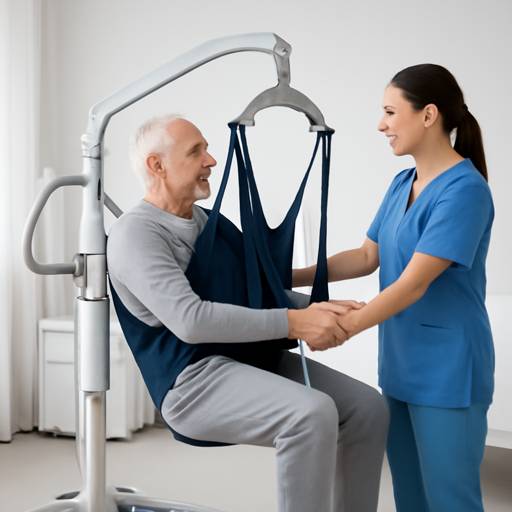
Redefining Patient Transfers: The Power Sit to Stand Lift Revolution
For healthcare professionals and caregivers, the simple act of moving a patient from a seated position to a standing one represents one of the most physically demanding and potentially hazardous tasks encountered daily. Traditional manual transfers place immense strain on the lower back and shoulders of caregivers, while also posing fall risks for patients with limited balance or strength. Enter the power sit to stand lift — a technologically advanced solution that combines mechanical advantage with ergonomic design. Unlike standard passive lifts that suspend a patient entirely, these devices work in partnership with the user’s own weight-bearing ability, promoting active participation in the transfer process. This approach not only preserves a patient’s dignity and mobility but also transforms the safety profile of the entire procedure. By integrating a powered lifting mechanism, controlled descent, and padded supports, modern sit-to-stand lifts have become indispensable tools in hospitals, long-term care facilities, and home health settings. Understanding how these machines function, who they benefit most, and the real-world evidence supporting their use is critical for any facility aiming to reduce worker injuries and improve patient outcomes.
Understanding the Mechanics and Benefits of a Power Sit to Stand Lift
A power sit to stand lift is engineered to bridge the gap between total dependence and independent mobility. At its core, the device consists of a stable base with locking casters, a vertical mast, a powered lifting arm, and a sling or vest that wraps around the patient’s torso and under the arms. The key differentiator from manual models is the electric actuator that raises and lowers the lift with the push of a button. This eliminates the need for the caregiver to exert physical force to hoist the patient. Instead, the lift provides smooth, consistent upward motion that mimics the natural standing sequence. The patient places their feet on a flat platform and holds onto handles or grips, while the lift gently assists them from a chair, wheelchair, or bed edge. The entire process reduces shear forces on the skin and minimizes the risk of sudden movements that could cause muscle strain or falls.
The benefits extend far beyond convenience. For caregivers, the reduction in manual lifting dramatically lowers the incidence of musculoskeletal disorders. Research consistently shows that repeated bending and twisting during patient transfers is a leading cause of occupational injury. A power sit to stand lift offloads the physical burden, allowing a single caregiver to manage transfers that would otherwise require two or three people. For patients, the lift encourages active weight bearing — a critical component in preventing muscle atrophy, improving circulation, and maintaining bone density. Those recovering from hip or knee surgeries, stroke survivors, or individuals with progressive neuromuscular conditions such as multiple sclerosis or Parkinson’s disease can all benefit from the partial weight-support approach. The lift also enhances the feeling of autonomy; instead of being passively transported, the patient participates in the transfer, which can boost morale and motivation during rehabilitation. Additionally, the controlled, slow speed of a power lift reduces the startle reflex and anxiety often associated with manual handling. When power sit to stand lift systems are deployed consistently, facilities report fewer patient falls during transfers and a measurable decrease in worker compensation claims.
It is essential to note that not every patient is a candidate. The user must be able to bear at least partial weight on their legs and have sufficient upper body strength and trunk control to hold the handles. A thorough assessment by a physical therapist or occupational therapist is recommended before implementing any sit-to-stand protocol. However, for the appropriate population, these lifts represent a gold standard in safe, dignified patient handling.
Clinical Applications and Real-World Scenarios for Power Sit to Stand Transfers
The versatility of power sit to stand lifts allows them to be used across a wide spectrum of clinical environments. In acute care hospitals, nurses frequently employ these lifts for post-operative patients who need to get out of bed for the first time after surgery. For example, a patient recovering from a total hip replacement needs to stand without violating the surgeon’s restrictions on hip flexion or adduction. The lift’s adjustable leg supports and sling positioning help maintain proper alignment, preventing dislocation while the patient bears partial weight. Similarly, in rehabilitation units, therapists use the lift to facilitate gait training. By providing just enough assistance to achieve upright posture, the device allows the patient to focus on stepping patterns and balance without the fear of collapsing. The lift can also be used to transfer patients onto commodes or into wheelchairs, simplifying toileting routines that often create the highest fall risks.
Long-term care facilities present another rich application landscape. Residents with dementia may resist transfer attempts due to confusion or fear. The smooth, quiet operation of a power sit to stand lift can be less startling than manual handling, encouraging cooperation. Care plans often include scheduled stand-and-pivot exercises using the lift to maintain the resident’s standing tolerance and prevent contractures. In home health settings, family caregivers who lack formal training in body mechanics find these lifts particularly life-changing. A single home health aide can safely transfer a spouse or parent from a recliner to a wheelchair without risking a back injury. The lift’s compact footprint and ability to roll over thresholds make it suitable for typical residential layouts.
Real-world case studies underline the impact. One skilled nursing facility in Ohio reported a 40% reduction in staff injuries within six months of replacing manual sit-to-stand devices with powered models. Another study published in a rehabilitation journal followed 30 stroke patients who used a power sit to stand lift for two weeks. At the end of the period, the average time needed to stand from a chair decreased by 30%, and patient-reported confidence scores improved significantly. These examples highlight that the lift is not merely a transfer tool but a rehabilitation enabler. It allows clinicians to safely push the envelope of what a patient can achieve, accelerating recovery while maintaining safety margins.
Sub-Topics: Battery Systems, Sling Design, and Load Capacities
Diving deeper into the technology, several sub-topics deserve attention for anyone evaluating a power sit to stand lift. First, battery systems are crucial for portability and reliability. Most modern lifts use sealed lead-acid or lithium-ion batteries that power the actuator for dozens of cycles per charge. Lithium-ion options offer longer life and faster recharge times, but they also increase the upfront cost. Facilities must consider their shift patterns and whether they need continuous operation without downtime. A backup manual override is a non-negotiable safety feature; in the event of a power failure, the caregiver should be able to lower the patient slowly using a hand crank or release valve.
Second, sling design directly affects patient comfort and transfer safety. Slings come in multiple sizes and materials, including breathable mesh for bariatric patients and padded options for those with fragile skin. Some lifts use a fixed vest-style sling, while others incorporate a knee pad that supports the patient’s shins during standing. The correct sling fit prevents pressure points and ensures the patient’s weight is distributed evenly. Training staff on proper sling application is as important as the lift itself. A poorly fitted sling can cause abrasions or fail to provide adequate trunk support, defeating the purpose of the device.
Third, load capacities vary widely. Standard lifts typically handle up to 400 pounds, but heavy-duty bariatric models can accommodate 700 pounds or more. Facilities must match the device’s capacity to their patient population. Additionally, the width of the base and the height range of the lifting arm are critical dimensions. A base that splits open to straddle a wheelchair or low bed allows the lift to get close to the patient, minimizing the need for awkward repositioning. Some lifts offer adjustable footplates and handle heights to accommodate patients of different statures. These engineering details, while often overlooked in marketing materials, directly impact the ease and safety of daily use. By paying attention to battery life, sling variety, and load limits, care teams can select a power sit to stand lift that integrates seamlessly into their workflow and delivers consistent, injury-free transfers year after year.